Author: walkboston

Comments regarding the transportation model underlying project design and operational decisions

Comments regarding the transportation model underlying project design and operational decisions

Re: Comments regarding the transportation model underlying project design and operational decisions

Dear FHWA Administrator McEwan and MassDOT Acting Director O’Dowd,

The I90 Allston Task Force met last night (December 11, 2019), the evening before today’s deadline for comments on the Allston I-90 NEPA Scoping Report.

The entire meeting (2+ hours) was consumed by a conversation about the model being used by CTPS (also to be used by MAPC on an additional study) to evaluate the requirements and impacts of the project. As became clear during the course of the presentation and Q&A, the assumptions about transit service that are built into the model will lead to results that point to very low use of West Station (45-60 minute headways during peak hours) and no use of the Grand Junction line (no service at all). The Task Force asked the project team for information about these assumptions a year ago because we were concerned about this issue and its potential impacts on the project review.

We ask that FHWA and MassDOT incorporate the meeting minutes of the Dec. 11 Task Force as WalkBoston’s comments about the Scoping Report because they reflect the serious questions needed to be answered about the basis on which project plans and designs will be made.

Most notably, if the model assumptions lead to results that show little to no use of West Station we fear that a number of decisions will be based on incorrect data:

  1. West Station will be put at risk because it will show such low ridership use
  2. Grand Junction components of the project will be at risk because there will seem to be no travel demand
  3. Bus, walking and biking elements of the West Station area will seem to be of little use because West Station will be shown as having very low use
  4. Sizing of roadway elements of the project (both highway and street elements of the project) will expand because almost all of the trips to be served will be modeled as vehicle trips – because such inadequate transit service has been baked into the model assumptions
  5. West Station and the rail service included in the project assessment will be at odds with the MBTA’s own plans for regional rail as recently voted on by the FMCB – thus putting the MEPA and NEPA analysis at risk for not conforming with state and local plans
  6. The I90 “Allston Multimodal Project” will be at odds with Massachusetts policies and goals regarding the reduction of GHG emissions because it will be premised on a vehicle-based transportation system – thus putting the MEPA and NEPA analysis at risk for not conforming with state and local plans

Thank you for the opportunity to provide comments, and for including the comments of the I90 Task Force in the project record.

Wendy Landman

WalkBoston Senior Policy Advisor and Task Force Member
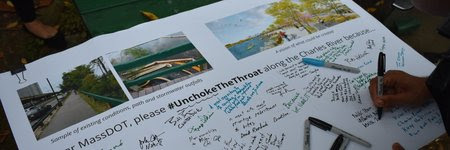
Please add your voice to the design and environmental review of MassDOT’s plans to rebuild the Mass Pike Allston Interchange!

Please add your voice to the design and environmental review of MassDOT’s plans to rebuild the Mass Pike Allston Interchange!

The federal environmental review for the I-90 project is about to begin, and there are elements of this project design that are causing us concern.

We need your help to submit comments on the design before Thursday, Dec. 12th 2019. Over 100 people emailed in February 2018, and it changed the process for the better. Can we count on you again?

DearMassDOT

Send an email to I-90Allston@dot.state.ma.us and cc: comments@dev.walkboston.org when you send it in!

Here are WalkBoston’s top five concerns with the current plan:

  1. The construction of West Station is not being accelerated, and the design of the tracks and station cannot accommodate the level of rail service that is needed to serve the Framingham-Worcester corridor or the Boston/Cambridge/Brookline neighborhoods near the station. The MBTA Board of Directors recently endorsed a plan to significantly increase the frequency of commuter rail service – MassDOT’s plan for West Station must align with that vision.
  2. The walking and biking connections provided in MassDOT’s proposal do not include the connections that we need between the Charles River path and Allston Village or Commonwealth Avenue including: a safer new Franklin Street Footbridge connecting North and South Allston, without the unsafe switchback hairpin turns currently included in design; a footbridge at Agganis Way to connect Allston, Comm Ave, and Boston University to the Charles River paths; and a new park and multi-use path built as a buffer between the Wadsworth Street neighborhood and the train tracks,
  3. The project’s purpose must include a plan to improve the quality and extent of the Charles River parkland, the storage and treatment of stormwater, the ecological health of the river, and the need to provide human access to the river’s edge.
  4. MassDOT must provide a detailed plan to effectively mitigate travel disruptions during the 10-year construction period. No additional rail or bus service has yet been described or offered and no commitment has been made to keeping two tracks in service on the Framingham-Worcester Line during construction.
  5. The construction plan described by MassDOT will have significant impacts on the Charles River for 10+ years. Project planning must include further review of design and construction alternatives to ensure that these impacts are mitigated and reduced to the greatest extent possible.

We need your help to speak up for the future of this project!

Below you’ll see an email template you can adapt and send to
I-90Allston@dot.state.ma.us and comments@dev.walkboston.org before next Thursday, Dec. 12 to make your voice heard.

Thank you for speaking up for a better Allston I-90!

Sincerely,
WalkBoston

Sample Email
Recommended email subject: Comments for Mass Pike’s Allston Interchange Project
Dear Allston I-90 Project Team,
I am writing to give my comments on MassDOT’s current project plan for the Mass Pike Allston Interchange project.
[Tell your own story here. Why are you concerned with this project? What do you support and what would you like to be considered? What points above would you like to include?]
Thank you,
[full name
street address
city/town, state, zip
phone:
email: ]

More Context + Reading on the Allston I-90 Project

job opportunities with partner organizations

job opportunities with partner organizations

Position: NACTO Conference Walkshop Manager

Description: The Cities of Boston, Cambridge, and Somerville are proud to serve as the hosts for the 2020 National Association of City Transportation Officials (NACTO) Designing Cities conference. The conference will bring together over 900 transportation professionals, primarily from municipal transportation departments, from September 14 – September 17, 2020. A vital element of this annual conference is the “walkshops” – mobile workshops that allow attendees to visit, learn about, and reflect on projects in the region. Approximately 50 walkshops take place over three days. Walkshops may include the following methods of transportation: walking, biking, transit, shuttle bus, and/or boat.

At the direction of the Primary Contact for the conference, the Walkshop Manager will work closely with staff from Boston, Cambridge, and Somerville to develop walkshops that cover a wide range of projects and present opportunities for attendees to learn directly from the people behind the projects. See full listing.

Position Dates: Contract position through 10/16/2020.

How to Apply: Submit both your resume and letter of interest via email to: employment@cambridgema.gov – resume and letter of interest requested by 12/13/19. Position will remain open until filled.


Position: Transportation for Massachusetts (T4MA) Policy Director

Description: T4MA is seeking an experienced Policy Director to promote our statewide coalition’s policy priorities to address the Commonwealth’s transportation crisis. See full listing.

How to Apply: Send resume and cover letter to info@t4ma.org with the subject line: “Policy Director Application.” Applications will be considered on a rolling basis, as we seek to fill this position as quickly as possible. No phone calls, please.


Position: Boston Cyclists Union Membership & Events Coordinator

Description: The Membership and Events Coordinator manages the Boston Cyclists Union’s rapidly growing membership, events, and volunteer programs. They manage and assist in planning fundraising events and rides, like Biketoberfest and Bostreal; recruit volunteers to help execute engagement events and programs; develop and execute communication strategies related to member recruitment, engagement, and retention; and collaborate with staff to explore other fundraising and development opportunities. Through the work they fulfill the Bike Union’s goals of growing and supporting our membership, and building the bike community and the network of bike-friendly businesses in the Boston area. See full listing.

How to Apply: Send cover letter and resume to jobs@bostoncyclistsunion.org. Please include “Membership, Events, and Development Coordinator, YOUR NAME” in the subject line of the email, and be sure to mention where you saw the job advertised. Applications will be considered on a rolling basis until the position is filled, with preference given to applications received by January 6th.

WalkBoston and MassBike comments on Waltham High School MEPA #16097

WalkBoston and MassBike comments on Waltham High School MEPA #16097

November 26, 2019

Secretary of Energy and Environmental Affairs Kathleen Theoharides
Executive Office of Energy and Environmental Affairs (EEA)
Attn: MEPA Office, Page Strysky
100 Cambridge Street, Suite 900
Boston MA 02114

Dear Secretary Theoharides, 

WalkBoston and MassBike have reviewed the MEPA filing #16097 for Waltham High School located at 554 Lexington Street in Waltham, MA. 

We are concerned with changes to Lexington Street that are included in the environmental filing: in particular, a new design speed of 45 mph, the removal of bicycle lanes in order to add additional general travel lanes, and poor connectivity. The changes are at odds with the Waltham Complete Streets policy as well as the recommendations put forth in the Waltham Transportation Master Plan (TMP) from January 2017. As proposed, this project will make Lexington Street more dangerous for all Waltham residents, even motorists. The segment of Lexington Street where the changes are proposed is, in addition to an important north-south arterial for motorists, bicyclists and pedestrians, a residential street lined with single-family homes and their driveways where residents turn left across oncoming traffic, and pull in and out.

Three of our major concerns from the filing:

  1. This project has set a new design speed limit of 45mph on Lexington Street near the new high school; the street previously varied between 40 mph, a 30 mph advisory speed, and 20 mph school zone. The AAA Foundation for Traffic Safety has found that the average risk of severe injury for a pedestrian struck by a vehicle reaches 10% at an impact speed of 16 mph, 25% at 23 mph, 50% at 31 mph, 75% at 39 mph, and 90% at 46 mph. The TMP noted that the Waltham Police Department identified speeding “as a significant issue” on Lexington Street. However, when a speed study was conducted for the high school project, the 85th percentile speed recorded was 41mph, leading to a new design speed set at 45mph. This does not mitigate the existing problem of speeding drivers on Lexington Street, but instead, legitimizes it. The purpose of this project should not be to maximize vehicle speed and throughput. On the contrary, the goal must be to create a safe access to the new high school for all modes and ages, especially the most vulnerable.

    A community should be safe for residents to get around, whether by walking, cycling, using transit, or in a vehicle. That safety and comfort is impacted by the design of our streets and intersections. All existing elementary schools in Waltham currently participate in the Massachusetts Safe Routes to School Program, which encourages students and their parents to walk and bike to school, something they hopefully would continue through high school. Parents also need to feel comfortable allowing their children to walk or bike to school. Many students walking to and from school will have to cross Lexington Street. A speed limit of 45 mph is not consistent with safe crossing by pedestrians, yet Lexington Street has the opportunity to see more students walking and bicycling to school in the years to come: a proposed new K-8 public school may occupy the site of the existing high school. With additional vulnerable road users in this area, it is important to ensure that anyone driving on Lexington Street is doing it at a safe speed, and that safe and comfortable facilities are provided for vulnerable users. The City should consider expansion of the 20mph School Zone on Lexington Street to include all three schools, or through creating a 20 mph “Safety Zone,” which was established in 2016 under Mass General Law Chapter 90, Section 18B.

  2. Existing bicycle facilities will be converted to shared-use lanes in order to accommodate turn lanes at the proposed intersections. This is not in accordance with the TMP recommended cross section for the Lexington Street Corridor, which included sidewalks and a consistent 6’ bike lane throughout the corridor on each side of Lexington Street, and has been implemented. Additionally, the TMP recommends any redesigns consult up-to-date design guidance. It is unlikely any guidance would pair an increased speed limit with the removal of bike lanes.

  3. Lack of non-Lexington Street connections to the site. If the high school is to be constructed at the Stigmatine site, paths should be constructed connecting it with residential neighborhoods to its north, south and west. These neighborhoods are within easy walking and bicycling distance of the Stigmatine property, as long as connections are established, with an opportunity significantly to reduce traffic to the site from Lexington Street and demand for parking. The initial plans show only access via Lexington Street, but supplemental filings include letters from the Police and Fire Department that reference potential emergency access routes to Lincoln Street and Jericho Hill Road that could be used by people walking or bicycling. These should be investigated further, as they could be an important option for encouraging walking and bicycling to the site, while excluding cut-through motor traffic. 

Potential solutions at the Stigmatine site are restricted by the additional problems that will be created on Lexington Street. We are hopeful that the city can consider more ways to use this project to back up the vision put forth in the TMP: “In addition to implementing physical improvements, easing today’s congestion and minimizing the congestion encountered in the future will require mode shift, smart land use planning, and mitigation on the state, City and private partnership level.” 

We encourage the MEPA office to take a deeper look at this project: the impacts are serious enough that it may require an environmental impact report.

Thank you, 

Brendan Kearney, Deputy Director, WalkBoston
Galen Mook, Executive Director, MassBike

Sampan News: “Gov. Baker signs legislation requiring hands-free use of electronic devices while driving”

Sampan News: “Gov. Baker signs legislation requiring hands-free use of electronic devices while driving”

Sampan News: “Gov. Baker signs legislation requiring hands-free use of electronic devices while driving

Stacey Beuttell, Executive Director of WalkBoston, added, “WalkBoston is pleased that this legislation has been signed; this law will encourage people driving to focus solely on that task, making streets safer for people walking & running in communities across Massachusetts. We’re hopeful that this long-awaited signing will kick off a focus on traffic safety for this next legislative session.”

Posted November 25, 2019