Author: walkboston

Lynn Fells Parkway at Melrose Street Intersection Comment Letter

Lynn Fells Parkway at Melrose Street Intersection Comment Letter

May 19, 2021 

Jeff Parenti
Deputy Chief Engineer, Division of Planning and Engineering
Department of Conservation and Recreation

Re: Lynn Fells Parkway at Melrose Street Intersection

Dear Jeff:

Thank you for the opportunity to provide comments for the proposed intersection improvements at Lynn Fells Parkway and Melrose Street. We are very excited to see DCR’s approach that improves safety for people walking and biking and adds traffic signals and upgraded crosswalks.

Design Concept 2 is our preferred approach for this intersection because it:

  • Significantly simplifies the intersection by closing the eastern end of Melrose Street to vehicles, in the process reducing conflict points and providing additional green space.
  • Offers improved visibility for pedestrians crossing to/from the north side of the intersection via curb extensions, and shortens the distance of the Lynn Fells Parkway crossing as recommended in our 2017 Melrose High School/Middle School Campus Bicycle and Pedestrian Accessibility Project Final Report.
  • Adds a new crossing in order to allow pedestrians travelling along the north side of Melrose Street to safely travel through the intersection without the need to traverse 3 crosswalks.
  • Several local residents voiced support for the concept at the Virtual Public Meeting on May 5, 2021.

We suggest considering several design details as the project advances:

  • Construct a 10.5’ shared use path along the north side of the intersection as demonstrated in Design Concepts 1 and 4, rather than a 6’ sidewalk and no dedicated space for cyclists on the road.
  • Close the second Dunkin Donuts drive-thru and convert the first drive-thru into a two-way operation in order to reduce conflict points for pedestrians, as explored in Design Concept 3 and supported by several local residents during the Q&A at the meeting on May 5.

Consider constructing continued bicycle lanes or a shared-use path along Lynn Fells Parkway, in order to provide cyclists with better separation from traffic than sharrows and ensure that the parkway is a pleasant travel experience for all users.

We look forward to seeing the next iteration of the project concept as it approaches final design.

Best regards,

Stacey Beuttell, Executive Director 

Comments on 2021 MUTCD Update

Comments on 2021 MUTCD Update

May 14, 2021

Stephanie Pollack, Acting Administrator
Federal Highway Administration
US Department of Transportation
1200 New Jersey Ave S.E.
Washington, DC 20590

RE: WalkBoston Comments on 2021 MUTCD Update

Dear Acting Administrator Pollack:

With this update of the MUTCD, the Federal Highway Administration has an opportunity to overhaul the current standards and create streets that are safe and equitable for vulnerable users, including people walking and biking. WalkBoston endorses the comments by America Walks, NACTO, Transportation for America, and Transportation for Massachusetts (T4MA) that recommend FHWA reframe and rewrite the MUTCD, creating a path for the creation of comprehensive safety-based guidance. Doing so will allow FHWA and the Biden Administration to make strides towards equity and sustainability, while reducing traffic deaths and serious injuries. 

We wanted to highlight a few issues that are of particular importance to people walking:

Accommodating pedestrians and bicyclists through construction work zones is often an afterthought. It is usually handled with pedestrian and bicycle facility closure signs which result in pedestrians and bicyclists experiencing significant out-of-direction travel, insufficient wayfinding for visually impaired pedestrians, or facilities that don’t meet the preconstruction level of multimodal facility accommodation.  

While the current 2009 MUTCD does outline the need to accomodate all modes throughout construction work zones, it fails to provide the same level of specificity and detail that motor vehicle-focused work zone treatments are afforded.  For example, there are only two pedestrian work zone examples (6H- 28/29) which shows a basic sidewalk closure and requirement for pedestrians to reroute around the work zone by crossing the street. Furthermore there are no bicycle work zone examples to draw from. This general lack of detail often results in the design and contractor community either utilizing the facility closure option or in many cases improvising.  

This ongoing update to the MUTCD provides a significant opportunity to bolster the level of design guidance so that the design and contractor community have better examples to draw from that reinforce that need to accomodate a similar level of facility and minimize out-of-direction travel throughout the work zone location.  The State of Vermont (VTrans) and New York City DOT establish good precedent examples for how to best accommodate pedestrians and bicyclists through construction work zones and should be considered as reference documents to be used in elaborating on best practice design guidance within the updated MUTCD.  

Speed limits are still based on the dangerous and disproven 85th percentile rule, and the draft MUTCD does not go far enough to implement the NTSB’s clear recommendation to no longer use this approach. We are grateful that during your term as Secretary of Transportation in Massachusetts, MassDOT started a review of speed setting policies in order to move away from strict reliance on the 85th percentile and take into account other factors, such as land use and the presence of vulnerable road users. We hope that you can bring that experience to inform the MUTCD on speed setting policies.

Outdated signal warrant requirements focus on the history of pedestrian deaths or current crossing demand, instead of known conflicts or planned land use changes. The MUTCD limits the installation of traffic signals because of the potential that they will slow car travel, and as result the guidelines place pedestrians at risk of being injured or killed – before new signals are recommended. We work with many Massachusetts rural villages that need protected crossings on state-owned highways that don’t satisfy the current crossing demand warrant standards. Kids need to walk to school and reach the library without the fear of speeding trucks barreling through the village center.

Pedestrian signal indications are not required at existing or even new traffic signals. We’ve heard from at least one municipality in Massachusetts that the new MUTCD standards will eliminate their ability to show a countdown running through the white man/walk phase, which has meant that going forward they cannot buy countdown units that display the countdown time remaining with people trying to cross the street. This is a change that not only is inconvenient for people walking, but it presents a potential unnecessary cost burden on communities to have to acquire new equipment going forward. We encourage you to ensure pedestrian signals are included at intersections and can display countdown time throughout the pedestrian phase.

Thank you for the opportunity to comment. 

Stacey Beuttell
Executive Director, WalkBoston
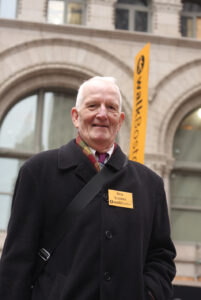
In Memoriam: Bob Sloane

In Memoriam: Bob Sloane

Please join us for a virtual celebration of the life of Bob Sloane on Thursday, September 9th from 5:30-6:30pm.

It is with great sadness that we announce that Bob Sloane passed away on May 12, 2021, after being hospitalized for several weeks. Bob was a true pioneer in walking advocacy and a pillar of our organization. He was a mentor, a friend and a creative genius when it came to getting the message out that walking is a fundamental part of the transportation conversation. Whether it was translating walking distances into time (for which he won a White House Champions of Change Award) or devising his latest plan to get separated walking paths, Bob knew how to persuade, engage and charm. We knew that if he was sitting in the conference room with trace paper and xerox copies of aerial photographs taped together, he was hatching yet another scheme to make it safer and more enjoyable for people to walk.

He is already missed for his incredible wisdom and wit. Please read his obituary, and make sure to read some of our favorite memories of Bob below – and share your own in this Google Doc. You can also use it to pass along a message to any of our staff or board members. 

There will be lots of ways to celebrate Bob and his legacy in the upcoming days, weeks, and months. For now, we hold him and his family in our hearts.

Read the Boston Vision Zero Progress Report – Year Five (2019 & 2020)

Read the Boston Vision Zero Progress Report – Year Five (2019 & 2020)

BOSTON VISION ZERO PROGRESS REPORT

YEAR FIVE – 2019 & 2020

Read Full Report

In 2015 the City of Boston committed to Vision Zero, a data-driven effort to eliminate serious and fatal crashes on city streets by 2030. Nearly six years later, the City of Boston has demonstrated consistent and measurable progress toward its goals, and has much to be proud of, including continuing to reduce pedestrian fatalities during a year when they skyrocketed across the country.

This year’s report includes a summary and evaluation of the City’s progress in both 2019 and 2020, along with specific recommendations for how Boston can continue moving toward its goal of eliminating traffic fatalities by 2030.

Read the full report here.

Boston has proven itself to be a national Vision Zero leader. The challenge moving forward will be maintaining momentum as the City recovers from COVID-19, addresses systemic racism, and continues to adapt to an ever-changing context.

Now is the right time for the City to revisit its Action Plan, reflect on how the landscape has changed, and present an updated roadmap to Vision Zero. The City should incorporate an emphasis on decreasing the number of single-occupancy vehicles on the road by increasing mode shift, as well as focus on removing police enforcement from the scope of its plan.

The MA Vision Zero Coalition (of which WalkBoston is a member) believes the City is positioned well to execute these recommendations and to continue on the right path toward meeting Vision Zero and Go Boston 2030 goals. The Massachusetts Vision Zero Coalition looks forward to continuing our strong relationship with the City of Boston to achieve our shared goals.

Read the full report here.

Streetsblog MASS: “A Walk Audit of Worcester”

Streetsblog MASS: “A Walk Audit of Worcester”

Streetsblog MASS: “A Walk Audit in Worcester

These photographs were all taken last December, for a virtual “walk audit” for the Indian Lake neighborhood that was hosted by WalkBoston, a statewide pedestrian advocacy organization, and WalkBike Worcester, a local advocacy group.

WalkBoston hosts walk audits all over the Commonwealth. Typically, they bring groups of people together to identify hazards and obstacles to foot traffic in a specific street of neighborhood. Since the pandemic began, WalkBoston has been conducting audits virtually, by sending advocates out to evaluate areas individually, collecting their findings via online forms, and discussing the results in group Zoom meetings.

“Even if what you’re seeing is depressing, the process is a tool to bring people together and build capacity and community assets to produce positive outcomes over the long run,” said LeighAnne Taylor, WalkBoston’s Program Manager and organizer of the Indian Lake event, in a phone conversation with Streetsblog after the walk audit. “Taking an inventory of all the issues is tedious, but it gives people an opportunity to make things happen when grants become available.”

Posted May 5, 2021