Author: walkboston

Call to Action Webinar 9/15/2015 – WalkBoston’s shared resources

Call to Action Webinar 9/15/2015 – WalkBoston’s shared resources

Thanks for tuning in to hear how advocates and local organizations can use the Surgeon General’s Call to Action on Walking and Walkable Communities. Below are resources that our executive director Wendy Landman will include in her remarks on 9/15.

WalkBoston Supports Surgeon General’s Call To Action on Walking

WalkBoston Supports Surgeon General’s Call To Action on Walking

US Surgeon General Launches Campaign with National Call to Action on Walking: Effort highlights health benefits of walking while addressing barriers to access

Today, the United States Surgeon General issued a call to action to address major public health challenges such as heart disease and diabetes. Step It Up! The Surgeon General’s Call to Action to Promote Walking and Walkable Communities articulates the health benefits of walking while addressing the fact that many communities unacceptably lack safe and convenient places for individuals to walk or wheelchair roll.

“We are thrilled that the Surgeon General is calling attention to the importance of walking and walkability to the health and well-being of Americans. We look forward to using the Call to Action as a stepping stone to making Massachusetts a safer, more convenient and more attractive place to walk,” said Wendy Landman, Executive Director of WalkBoston, Massachusetts’ leading pedestrian advocacy organization.

Data consistently show there are safety and accessibility issues that make communities less walkable. A 2013 study by the U.S. Department of Transportation, for example, found that three out of every 10 Americans reported that no sidewalks existed along any streets in their neighborhood. In many communities violence – and the perception of violence – may prove a barrier to walking.

“Everyone deserves to have a safe place to walk or wheelchair roll. But in too many of our communities, that is not the reality,” said Dr. Vivek H. Murthy, the 19th U.S. Surgeon General. “We know that an active lifestyle is critical to achieving good overall health. And walking is a simple, effective and affordable way to build physical activity into our lives. That is why we need to step it up as a country ensuring that everyone can choose to walk in their own communities.”

The Surgeon General calls on community planners and local leaders to create more areas for walking and wheelchair rolling and to prioritize the development of safe routes for children to get to and from schools. The call to action suggests that these designs should include sidewalks, curb cuts, crosswalks, safe crossings for the visually impaired and more green spaces. The Surgeon General further calls on city managers, law enforcement and community and public health leaders to address safety concerns by better maintaining public spaces, working with residents to promote a shared sense of community ownership, ensuring proper street lighting and fostering neighborhood watch programs.

The Surgeon General’s report discusses the health benefits of walking and calls on individuals to make walking a priority in their lives. Fewer than half of all U.S. adults get enough physical activity to reduce their risk of chronic disease, and only a quarter of high school students get the recommended amount. Physical inactivity contributes to heart and lung disease, diabetes and cancer, which account for 86% of our nation’s health care costs. Building walking into daily life can reduce disease and save money.

“We know that an average of 22 minutes a day of physical activity – such as brisk walking – can significantly reduce the risk of heart disease and diabetes,” added Dr. Murthy. “The key is to get started because even a small first effort can make a big difference in improving the personal health of an individual and the public health of the nation.”

WalkBoston makes walking safer and easier in Massachusetts to encourage better health, a cleaner environment and vibrant communities. Founded in 1990, WalkBoston’s goal is to make walking and pedestrian needs a basic part of the transportation discussion. Current WalkBoston efforts include work on Vision Zero, a comprehensive and coordinated strategy to eliminate traffic fatalities and injuries in Boston, and the recent publication of a guide for low-cost traffic calming solutions. Low-cost fixes to calm traffic and enhance safety on municipal streets and state roads can be a great place to start, and can serve as catalysts for long-term change.

To read the Surgeon General’s Call to Action and learn how to promote walking and walkable communities, please visit www.surgeongeneral.gov
# # #
Follow the Surgeon General on Twitter @Surgeon_General, on Facebook, and on Instagram – Join the conversation: #StepItUp

————————————————————————————————

Join our Mailing List to keep up to date on advocacy issues.

Like our work? Support WalkBoston – Donate Now!
Connect with us on Twitter and Facebook

Check out our new report – Pedestrian Infrastructure: Strategies for improving pedestrian safety through low-cost traffic calming.” (Click for instructions to download PDF). 

Low cost fixes to calm traffic and enhance safety on municipal streets and state roads can be a great place to start, as they are likely to be adopted and completed sooner than more expensive projects, and can serve as catalysts for long-term change.

This report was prepared by WalkBoston for Mass in Motion, an initiative of the MA Department of Public Health.

————————————————————————————————

Join our Mailing List to keep up to date on advocacy issues.

Like our work? Support WalkBoston – Donate Now!
Connect with us on Twitter and Facebook
Taunton Walk Assessment

Taunton Walk Assessment

Taunton, founded in 1639, has a dense development pattern with narrow streets, and therefore is quite walkable. Many of the two lane streets have mature trees and flowerbeds, and several assessment attendees, including the WalkBoston team, commented on how attractive and clean the streets were, with the exception of portions of Adams Street. Hospital employees said that they were able to take a one-mile walk on their break without having to cross Broadway, a more heavily traveled street. Attendees also noted that cars were traveling at moderate speeds.

Read the full report:
WalkBoston-WalkAssessement-Taunton

Weymouth: Making Safe Routes for Seniors

Weymouth: Making Safe Routes for Seniors

by Nicholas Bulens, Grant Writer & Researcher, Town of Weymouth

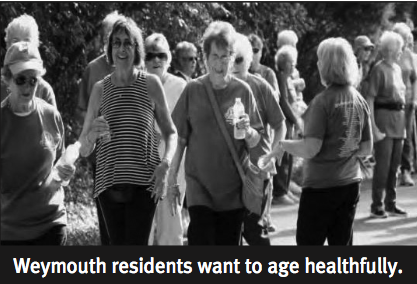
In the summer of 2014, WalkBoston partnered with the Town of Weymouth to open a conversation between municipal staff and older adults about creating a safer, more attractive walking environment. The Safe Routes for Seniors initiative was a true convergence of advocacy and policy, resulting in a set of design guidelines and program alternatives to better coordinate the town’s
capital planning process with greater walkability. The initiative has helped springboard Weymouth toward a healthier approach to community design.

Weymouth is a mature suburban community situated about 12 miles southeast of Boston. The town has a strong residential character with many attributes of a walkable environment. Weymouth has four village centers, each featuring a mix of land uses that helps create a sense of place for residents. It also has a diverse open space network interspersed among many settled neighborhoods. There is also a good mix of transit services, including commuter rail and bus, which help connect Weymouth’s people and places. However, in spite of these attributes, the town has grown increasingly dependent on the automobile for transportation in the last 50 years. Simultaneously, Weymouth’s population has aged and diversified to where almost one in every four residents is over age 60.

Recognizing a need to analyze the built environment from a healthy aging perspective, Weymouth received a grant from the Massachusetts Council on Aging, in partnership with the Massachusetts Department of Public Health [MDPH], to conduct a senior pedestrian safety study. Municipal staff collected data on Weymouth’s housing, land use and pedestrian crashes. The data led the town to identify four areas of need where seniors could most benefit from improved walking conditions.

WalkBoston facilitated a public meeting between municipal staff and an audience of over 30 older adults. Residents raised important concerns about poorly maintained sidewalks, obstructed lines of sight and distressed crosswalks. WalkBoston then hit the streets with a diverse focus group of municipal staff, senior residents and local businesspeople. A wealth of observations were made, and ideas flowed freely between stakeholders.

Weymouth’s walkability investigation culminated in the publication of the Safe Routes for Seniors Design Guidelines and Planning Report. WalkBoston introduced municipal staff to new and innovative approaches to streetscape improvements, including “lighter quicker cheaper” placemaking, which could facilitate safer, more frequent foot traffic by older adults in the town’s target areas. Weymouth’s planning staff prepared the final report to summarize the initiative’s findings and recommend design guidelines for town planning moving forward.

The Safe Routes for Seniors initiative has already led Weymouth to take a number of steps toward enhancing walkability. For 2015, Weymouth’s Mayor Susan Kay has committed $150,000 to sidewalk improvements and indicated that she will budget up to $250,000 for the same purpose each year thereafter. Plans are also under way by municipal staff to develop a Complete Streets policy and apply for certification under the MassDOT’s new Complete Streets program. In addition, the town has received a technical assistance grant from the MDPH to develop a zoning action plan with the Pioneer Valley Planning Commission [PVPC], a leader in the movement to design healthier communities. The PVPC will advise Weymouth on how to facilitate healthy eating and more physical activity in the community through changes to local zoning provisions, such as reduced parking requirements and site plan review.

This article was featured in our Summer 2015 newsletter. See the full newsletter & past editions here.

——————————————————————————————————————-
Join our Mailing List to keep up to date on advocacy issues.

Like our work? Support WalkBoston – Donate Now!
Connect with us on Twitter and Facebook

image